
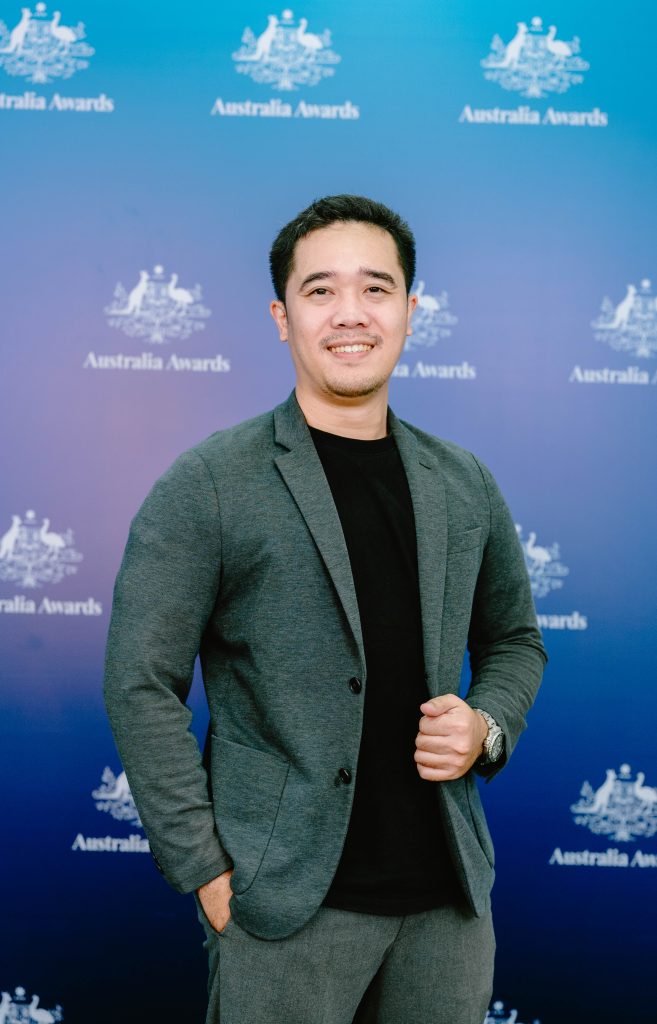
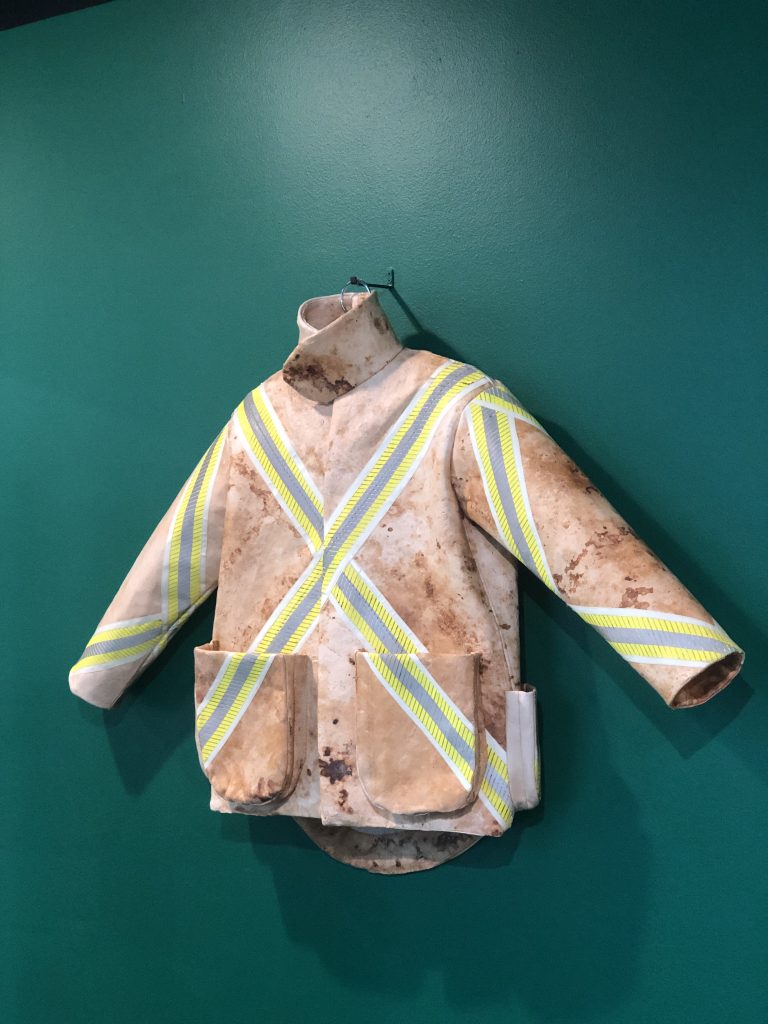
What if agricultural waste could be transformed into a material that helps protect people from bushfires? For Indonesian Australia Awards scholar Mohamad Arekha Bentangan, that question has shaped years of research into mycelium, the root-like structure of fungi. Now, his work is being showcased at the National Gallery of Victoria’s world premiere exhibition Plant Life: The Nature of Design. His Mycelium Wildfire Jacket demonstrates the potential of renewable, fungi-grown materials for future protective clothing. In this Q&A, Arekha reflects on the experiences, skills and opportunities gained through his Australia Awards Scholarship that helped bring this innovative project to life.
What sparked your interest in plant-based and renewable materials?
My interest began well before I started my PhD study. Together with my partners, I co-founded MYCL, a biotechnology company in Indonesia focused on developing sustainable materials from fungal mycelium. What drew me in was a simple belief. Fungi are not only a source of food and medicinal compounds, they can also help solve much broader human challenges, and a sustainable leather-like material grown from mycelium is one clear example. I want to highlight to the fact that growing this material uses agricultural waste biomass, which is produced in large volumes in both Indonesia and Australia. Turning that waste into a valuable material felt like the right problem to work on.
How did you get involved in the exhibition?
My involvement came through a connection between two schools at RMIT. As the microbiologist on the project, I was introduced by my supervisor, Associate Professor Tien Huynh from the School of Science, to Dr Judith Glover, an industrial designer from the School of Design, and bio-designer Alexi Freeman. When Dr Glover learned about our work developing a mycelium leather-like material for thermal protection, we saw a chance to combine our expertise. She brought design and product knowledge, and my supervisor and I brought the material science. We were excited to test this mycelium material as a functional prototype, which became the Mycelium Wildfire Jacket. Together, we pitched this collaboration to the exhibition of “Plant Life” at the National Gallery of Victoria (NGV).
Why did you want to create a wildfire jacket?
Mycelium is made up mainly of beta-glucan and chitin, and this structure makes it naturally resistant to heat. One of its most useful attributes is its ability to act as a fire-retardant material, which made a wildfire jacket a compelling proof of concept. Firefighters today wear synthetic material, very heavy cotton, or wool based clothing to stay protected, but that clothing is heavy and hot to work in. As summers in Australia grow hotter and bushfire conditions become more common, there is a real opportunity to offer lighter clothing that still protects while reducing some of the physical burden of long hours in extreme conditions. Through this project I wanted to show that mycelium leather can move beyond fashion and accessories into a functional prototype that can be tested for comfort and protection against existing products.
How did your scholarship contribute to this work?
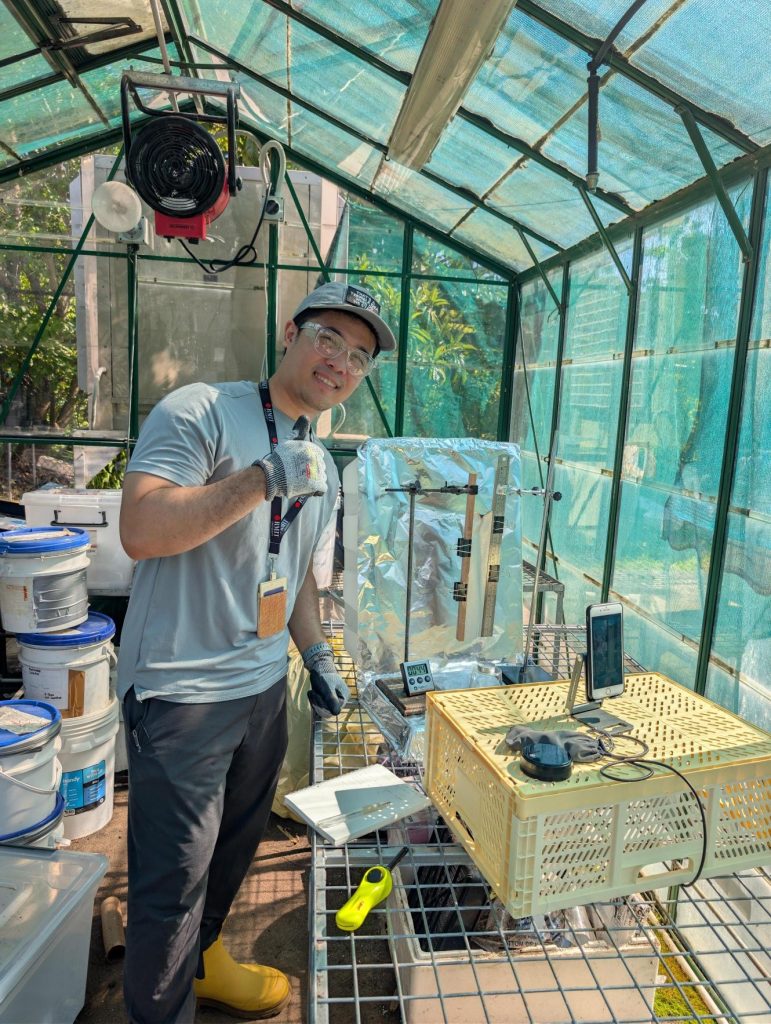
None of this would have taken shape the way it has without the Australia Awards Scholarship and the opportunity it gave me to study in Australia. I chose RMIT specifically because my supervisors are among the leading experts in the mycelium material field in the world, and learning directly from them was the best way to deepen my work on mycelium materials technology. The pre-departure training and the Introductory Academic Program by Australia Awards before starting my study really helped me get ready for studying in an Australian university. Because of that I adapted quickly and could start my PhD research sooner. The training also built up my academic, communication, and collaboration skills, and those became the mindset I brought to working across different fields while we developed the mycelium wildfire jacket.
Why is it so important to explore sustainable materials?
I believe exploring sustainable materials matters because the old way of making things, using finite resources and creating endless waste, simply is not working anymore. Finding eco-friendly alternatives allows us to build, design, and live without constantly draining the planet’s resources. We cannot afford to wait until we are forced to find replacements only because the environmental damage has become unbearable. By the time that happens, it will already be too late.
Why is this particularly important in your country?
In Indonesia, agricultural industry produces enormous volumes of waste biomass every year, much of which is burned or discarded. That wastes a valuable resource and adds to environmental harm. Developing materials from mycelium gives that waste a second life and creates local value from something that would otherwise be thrown away. This matters even more when you consider that conventional leather carries a heavy environmental burden. Synthetic leather is made from petroleum and does not break down, shedding microplastics and leaving waste that lasts for decades. Animal-based leather brings its own problems, from the land and emissions tied to livestock to the chromium tanning process, which can produce toxic wastewater that pollutes soil and rivers. A mycelium leather grown from agricultural waste avoids both of these paths. It also has the potential to create new green jobs and build new skills within local communities, from cultivating the material to processing it, keeping that value close to where the raw waste is produced. Building this capability in Indonesia means the country can take an active part in the shift toward sustainable materials rather than depending on imported solutions.
